Why Economists Are Warning the Iran War Needs to End Before the Reserves Run Out
The stockpiles cushioning oil markets are running down at the same time forecasters are raising recession odds and stocks are already sliding. The economic warnings are converging on one conclusion: this needs to end.
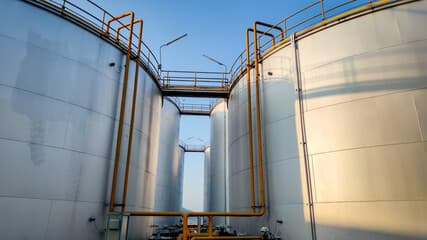
Three separate warning signs are now flashing at once: recession odds climbing at major forecasters, stock markets already sliding, and the strategic oil reserves that have kept prices in check running toward empty on parallel timelines in Washington and Beijing. None of these are speculative — they're the current, published positions of the institutions whose job is to track exactly this kind of risk. Taken together, they add up to an economic case for ending the Iran war that is becoming harder for policymakers to ignore.
The recession odds are already elevated
Moody's chief economist Mark Zandi wrote recently that a US recession is "once again a serious threat," with the firm's models putting the odds of a recession beginning within the next 12 months at 49 percent — essentially a coin flip. That's not a fringe call. It reflects a broader consensus shift: as global oil inventories have been drawn to historic lows in both the US and China, the cushion that had kept prices from spiking is now itself a source of risk, because there is very little capacity left to absorb the next shock.
The IMF has laid out a severe scenario in which oil and natural gas prices spike 100 to 200 percent above January levels and stay there into 2027 — a path that would leave global economic growth at just 2 percent this year, which the Fund has described as "a close call for a global recession." The IEA, separately, has already labeled the current disruption the largest supply shock in the history of the global oil market.
Europe is arguably more exposed than the US
The European Central Bank has warned that energy-intensive economies face a high risk of technical recession if the maritime blockade around the Strait of Hormuz persists through the summer refill season — the period when European utilities and industry typically restock gas supplies ahead of winter. Economists at Germany's Ifo Institute have flagged Germany and the Netherlands specifically as high-risk economies, given how directly their industrial bases are exposed to energy price swings.
Markets are already pricing in the strain
This isn't a purely theoretical risk sitting in forecasts. US equities have already been sliding through July: the S&P 500 fell 0.79 percent in a recent session, the Nasdaq dropped 1.55 percent, and the semiconductor sector — often an early bellwether for broader market stress — is down roughly 20 percent from its recent highs. Oil prices themselves have been extraordinarily volatile, spiking to a peak near $112 a barrel in early April, falling back toward $67 by late June and early July, and then jumping again — crossing $75 and later climbing above $80 — once the naval blockade and the new 20 percent Hormuz transit toll were reimposed in mid-July.
The reserves were buying time, not solving the problem
That volatility is exactly what the drawdown of both the US Strategic Petroleum Reserve and China's crude stockpiles has been holding at bay. The US reserve is already sitting at its lowest level since 1983. China has burned through close to a billion barrels of its own stockpile, with most estimates putting its reserves near operational minimums by the third quarter of this year. Both buffers were bought — and are being spent — as time, not as a solution. They lower the price today at the cost of removing the cushion that would otherwise absorb tomorrow's shock.
What the warnings add up to
None of this requires speculation about where the war "should" go politically to reach a fairly stark economic conclusion: the reserves currently protecting global growth from the full force of this conflict are approaching exhaustion on a timeline that roughly matches the recession warnings now coming from Moody's, the IMF, and the ECB. When both stockpiles are gone, the next disruption — a new round of strikes, a further closure of Hormuz, any fresh escalation — will hit a market with essentially no shock absorber left. That is the argument, increasingly made not by activists but by the economists whose job is to model exactly this kind of risk, for ending the war before the reserves run out rather than after.
Frequently asked questions
What are the current odds of a US recession tied to the Iran war? Moody's chief economist Mark Zandi has put the odds of a US recession beginning within 12 months at 49 percent, citing sustained high oil prices tied to the conflict.
How is the Iran war affecting the stock market? US equities have declined through July 2026, with the S&P 500, Nasdaq, and semiconductor stocks all falling as oil prices spiked following the reinstated naval blockade and Hormuz transit toll.
Why do falling oil reserves increase recession risk? Strategic reserves in the US and China have been cushioning global oil prices during the conflict. As both approach exhaustion, there will be less capacity to absorb any future supply shock, raising the risk of a sharper price spike and broader economic damage.
Sources: CNBC, CNN Business / IMF, CBS News, TheStreet, NPR
More from News

Houthi-Saudi Red Sea Truce Collapses: Aramco Sites Struck, Hodeidah Bombed, Maritime Embargo Declared
A four-year informal truce between the Houthis and Saudi Arabia has broken down within days: Houthi forces struck Saudi Aramco's Red Sea facilities, the Saudi-led coalition bombed Houthi positions in Hodeidah, and the Houthis have now declared a maritime embargo.

Iran War Latest: Strikes Stay Paused as Jordan Downs Drones and a Second Front Risks Opening in the Red Sea
The US bombing pause on Iran is holding into a second week, but Jordan has shot down two drones, Japan is urging Iranian flexibility, and a fast-deteriorating Houthi-Saudi standoff in the Red Sea threatens to open a second front while Hormuz remains shut.

Iran War Update: US Strikes Pause After 13 Nights as Oman Brokers Progress on Reopening Hormuz
For the first time in two weeks, the US did not announce new strikes on Iran this weekend. Tehran is calling the pause a victory while its foreign ministry reports progress in Oman-mediated talks on reopening the Strait of Hormuz — even as a separate incident with Ukraine and rising fuel prices complicate the picture at home.